Apartment inspection before buying in Albania: 30 checks, from cracks to unpaid electricity and water bills
An apartment inspection before buying in Albania in 30 checks: cracks, damp, water, wiring, windows, the lift, building management and debts with OSHEE, the water utility and the municipality. What to check when you buy an apartment, with the official rules.
By Ekipi i hyrja.alEditorial policy15 min read
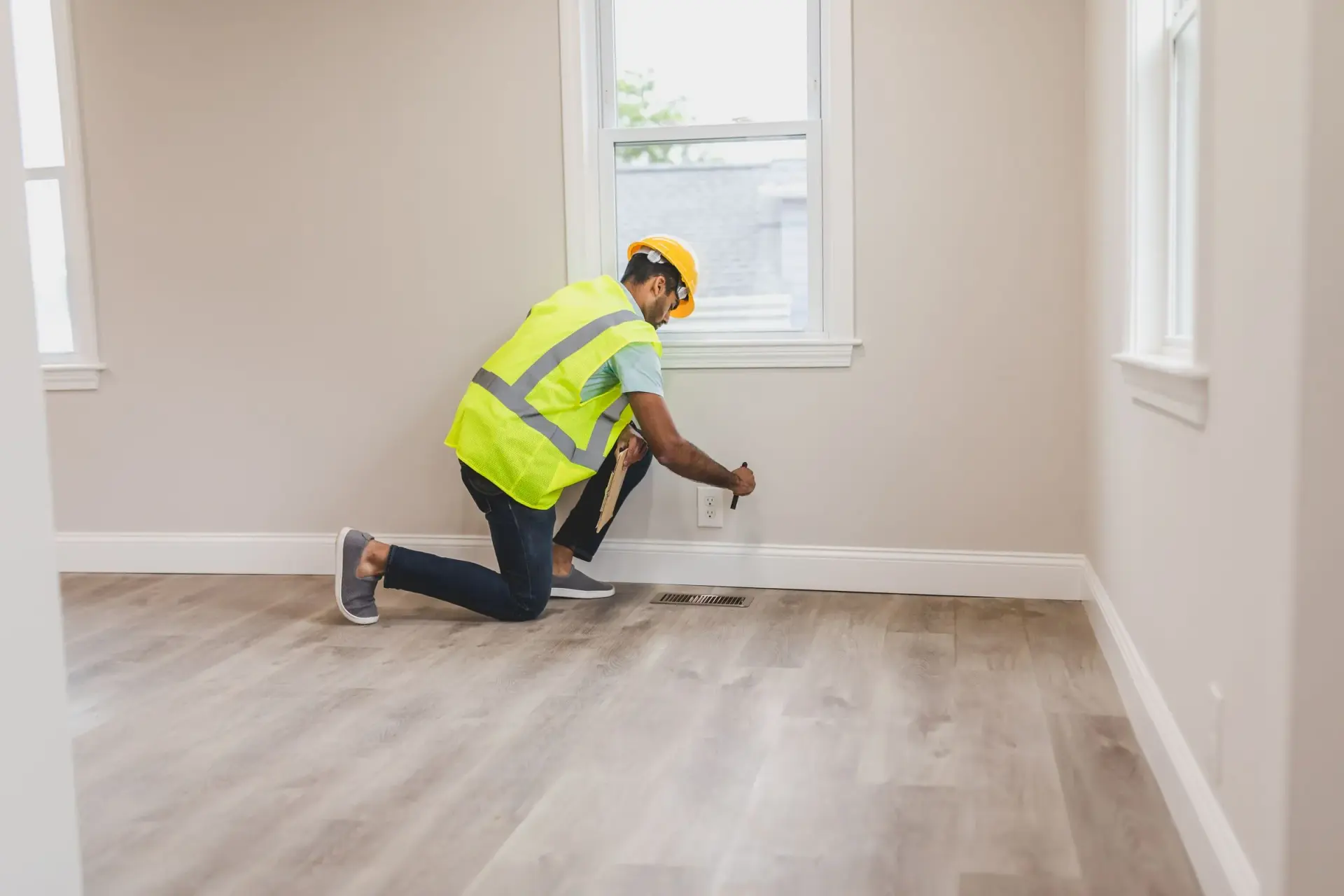
An apartment inspection before buying in Albania has three parts: the apartment itself (cracks, damp, water, wiring, windows and noise), the building (lift, roof terrace, parking and building management) and the debts that could be left to you with OSHEE (the electricity supplier), the water utility, the municipality and the building administrator. Do it before you pay the deposit, in two visits, one in the daytime and one in the evening. Below are the 30 checks and the official rules behind them, verified on 10 October 2026.
Main photo: RDNE Stock project / Pexels
- Average daily water supply in Albania in 2025; 17 in Tirana, 10.9 in Durrës (ERRU)
- 17.2 hours
- Periodic lift inspection in a residential building (Council of Ministers Decision no. 1056/2015)
- 12 months
- Changing the name on the OSHEE electricity contract, when there is no debt or the debt is taken over
- 300 lek
- Deadline to challenge defects in a property you bought, from handover (Civil Code, article 756)
- 5 years
hyrja.al does not assess the condition of the properties it publishes or their build quality, so you carry out these checks yourself or with a specialist you choose. The ownership documents are checked separately, at ASHK (the State Cadastre Agency, Agjencia Shtetërore e Kadastrës): see the ownership certificate online and the documents for buying a home.
Bring a tape measure, to compare the floor area with the one on the property record and the floor plan, your phone torch and a charger to test the sockets. Ask permission to open the taps and windows, and photograph anything that looks suspicious.
How do you tell which cracks need an engineer?
Fine cracks in the plaster are common and often only cosmetic. Be careful with diagonal cracks running from the corners of doors and windows, cracks in beams or columns, doors that stick and sloping floors. In these cases, or when the building is old, ask a licensed structural engineer for a written opinion before you pay the deposit; more in earthquakes and building safety.
Photo: Marina Zasorina / Pexels
Also ask whether any walls have been removed. As a rule, load-bearing walls are not part of your unit, even when they are inside the apartment, and no change may affect the stability of the building (Law no. 55/2025 on co-ownership, articles 5 and 40). For other changes, read enclosing a balcony and changes to an apartment.
Where do damp and mould hide?
Damp appears where air circulates little: in the corners of external walls, behind wardrobes, under windows and on the bathroom ceiling. Look for stains, bubbles in the paint and black spots, and use your nose; fresh paint in just one corner is a reason to ask. The World Health Organization links indoor damp and mould with more respiratory symptoms, allergies and asthma.
On the top floor, ask when the roof terrace was last repaired: it is common property and is maintained with money from all the co-owners (Law no. 55/2025, articles 6 and 38). For a leak from the floor above, the owner who caused it is responsible (article 41); ask whether the cause has been fixed, not just the stain.
How do you check the water, drains and wiring?
Open the kitchen tap and the shower at the same time to see the pressure, flush the toilet and see whether the drains empty quickly and without smells, and look for drips under the sinks and around the water heater. Ask how many hours a day the water runs and whether the building has a tank and pump. According to the 2025 Performance Report of ERRU, the water regulator, the average supply was 17.2 hours a day: 24 hours only in the Lezha area, 10.9 in Durrës and 4 in Kamza. These are averages for each utility's whole area, so also ask the neighbours how it is in the building.
| Category | Value |
|---|---|
| Lezha | 24 hours/day |
| Pogradec | 23.9 hours/day |
| Korça | 23.5 hours/day |
| Berat | 22.5 hours/day |
| Dibra | 22 hours/day |
| Shkodra | 21.6 hours/day |
| Gjirokastra | 21.4 hours/day |
| Saranda | 21 hours/day |
| Fier | 18 hours/day |
| Elbasan | 18 hours/day |
| Lushnja | 17 hours/day |
| Tirana | 17 hours/day |
| Kukës | 14 hours/day |
| Vlora | 13 hours/day |
| Durrës | 10.9 hours/day |
| Vora | 8 hours/day |
| Kamza | 4 hours/day |
In the electrical panel, look for circuit breakers for the different circuits and a residual current device, which cuts the power when there is a leak. Check whether the sockets are earthed, because this may be missing in old buildings. For old wiring, ask an electrician for a quote; the cost of the work is in renovating an apartment in 2026.
What should you look at in the windows, light and noise?
Open and close every window: condensation between the panes of double glazing shows the seal has failed, while cracked rubber seals let in air, noise and damp. Energy bills from one winter and one summer show what heating and cooling cost; the full comparison is in the article on monthly apartment running costs.
Go back in the evening, ideally at the weekend, and listen with the windows closed and open: the street, bars and cafés, the lift and the building's pumps. How the floor and orientation affect light, price and bills is explained in the article on floor, orientation and view.
What should you check in the building?
The roof terrace, façade, stairs and lift are common property, and you also pay for their repairs according to your share (Law no. 55/2025, articles 6, 38 and 39). Walk up to the top floor and look at the basement and the façade: falling plaster and visible rusty reinforcement bars are a reason to ask questions.
The lift
The lift car should have a plate with the load, the number of people and the dates of the periodic inspection, the last one and the next one (Council of Ministers Decision no. 1056/2015, point 3.2). In a residential building, an approved body inspects the lift once every 12 months and it is serviced at least once a month (points 7.5 and 10.5). The administrator takes care of this (Law no. 55/2025, article 26), while supervision is the job of the Central Market Surveillance Inspectorate, formerly ISHMT.
Parking
If the price includes a parking space or garage, ask for it to be registered at ASHK as a separate property: Law no. 55/2025 lists parking among the common parts when it has not been assigned for individual use (article 6). More in parking spaces and garages.
Building management and neighbours
Ask how much the building management fee is, what it covers and whether there is a reserve fund. The fee is calculated from the expenses and each owner's share, the assembly decides how it is paid, and every month of delay adds interest of 30% of the fee (Law no. 55/2025, articles 32 and 33). When fees have not been paid for at least 12 months, or the debt reaches 0.5% of the apartment's value, the administrator can register at ASHK, by decision of the board, a restriction that blocks the sale until the debt is paid (article 34).
Major works, such as a new lift, are approved by at least 75% of the shares (article 39) and you pay for them too; more in building management. Then talk to a neighbour: in five minutes you learn more about leaks, noise and water than in an hour with the seller.
How do you find out whether there are unpaid electricity, water and tax bills?
Ask the seller for written certificates for every obligation, before the deposit or at least before the final payment.
| Electricity | OSHEE: online portal or customer centres | The debt certificate and the last paid bill |
|---|---|---|
| Water in Tirana | UKT: bill portal or the 18 customer points | The last paid bill, with the building tax and the cleaning fee |
| Water in other cities | The local water and sewerage utility | The last paid bill |
| Property taxes | Municipality | The payment certificate, which ASHK requires for registration |
| Building management fee | Administrator | Written confirmation that there are no unpaid fees |
| Mortgage, seizure, lawsuit or restrictions | ASHK, property record | A freshly issued property record |
Electricity. Under the regulation of the Energy Regulatory Authority (ERE), the contract holder is responsible for the electricity used until the contract ends (point 6.6). But OSHEE only changes the contract holder's name when the customer has no debt, or when someone takes over the debt with a notarised declaration; the service costs 300 lek. The contract holder requests the debt certificate on the OSHEE online portal; the steps after the purchase are in after buying a home: the first steps.
Water and taxes. In Tirana, the household water bill also includes the monthly instalment of the building tax and the cleaning fee, which Ujësjellës Kanalizime Tiranë (UKT, the Tirana water utility) collects for the Municipality (Municipal Council Decision no. 158/2019, articles 9, 12 and 42). An unpaid bill can therefore hide unpaid taxes, while ASHK does not register the sale without the municipality's certificate for property taxes (Law no. 9632/2006, article 24). For mortgages, read a mortgage on a property.
Do not leave the settling of debts until after signing. Write in the contract that the seller pays all bills up to the handover date and, if the seller agrees, tie the final payment to the handover of the keys. On that day, photograph the electricity and water meters.
What should you ask the seller?
Ask for the answers in writing, even by message:
- What has been renovated, when and by whom?
- Have there been leaks, damp or damage from the neighbours, and how were they resolved?
- How much do you pay a month for electricity, water and building management?
- What stays in the apartment: furniture, appliances, air conditioners?
- Is the apartment rented out, and until when?
- Do you have disputes with the neighbours, the administrator or in court?
The question about renting carries legal weight: a lease with a certain date before the sale is binding on the buyer, who must respect it (Civil Code, articles 822 and 825). Turn the important answers into clauses of the preliminary sale contract, and if defects need work, compare the price with the free property valuation before you make an offer.
What happens with defects that appear after the purchase?
On handover day, inspect the apartment again and record its condition and the meter readings, with photos, in a handover report signed by both parties. For an apartment bought from another owner, the right to challenge defects expires five years after handover (Civil Code, article 756). There are separate rules for a floor area smaller than in the contract, with a two-year deadline (articles 752 to 755): see gross and net floor area of an apartment.
If you take the apartment from the developer
Under a construction contract you have the right to inspect the apartment before handover, and if you accept it without any reservation, the work is considered accepted (Civil Code, article 863). Once you accept it, the warranty does not cover defects you knew about or that were recognisable, unless they were concealed in bad faith; you report the others within 60 days of discovering them, and the claim expires two years after handover (article 864). For collapse or serious construction defects, the developer is liable for ten years from completion, provided you report them within one year of discovering them (article 866). Check the building permit and the occupancy certificate following the guide how to buy an off-plan apartment; all the steps are in how to buy a home in Albania.
How often is the lift of a residential building inspected?
Frequently asked questions
Sources
- OSHEE: ndryshimi i emrit të titullarit të kontratës (dokumentet, kushti pa borxh, tarifa 300 lekë) ·
- OSHEE: manuali i portalit online, moduli “Vërtetim Debie” ·
- ERE: Rregullorja mbi kushtet e përgjithshme të shërbimit të furnizimit me energji elektrike për klientët fundorë (vendimi i Bordit nr. 203/2017), pika 6.6 ·
- Ujësjellës Kanalizime Tiranë: konsultimi i faturës online ·
- Ujësjellës Kanalizime Tiranë: pikat e kujdesit ndaj klientit ·
- Bashkia e Tiranës: Vendimi i Këshillit Bashkiak nr. 158, datë 26.12.2019, nenet 9, 12 dhe 42 ·
- Bashkia e Tiranës: Programi Buxhetor Afatmesëm 2026-2028, agjentët tatimorë ·
- Ligji nr. 9632/2006 “Për sistemin e taksave vendore”, i përditësuar më 16.1.2026, neni 24 ·
- Ligji nr. 55/2025 “Për administrimin e bashkëpronësisë në ndërtesa”, nenet 5, 6, 26, 32 deri 34, 38 deri 41 dhe 57 (shfuqizimi i Ligjit nr. 10 112/2009) ·
- VKM nr. 1056, datë 23.12.2015, rregulli teknik “Për sigurinë e ashensorëve në përdorim”, pikat 3.2, 7.5 dhe 10.5 ·
- VKM nr. 643, datë 2.10.2019, ndryshime në VKM nr. 1056/2015 ·
- Inspektorati Qendror i Mbikëqyrjes së Tregut: emërtimi i ri sipas VKM nr. 490, datë 26.06.2026 ·
- ERRU: Raporti i Performancës 2025 për shoqëritë ujësjellës-kanalizime, tabela nr. 19 ·
- ERRU: prezantimi i Raportit të Performancës 2025, 7.10.2026 ·
- Kodi Civil (Ligji nr. 7850/1994), teksti i përditësuar më 10.8.2026: nenet 752 deri 756, 822, 825 dhe 863 deri 866 ·
- Organizata Botërore e Shëndetësisë: udhëzimet për cilësinë e ajrit të brendshëm, lagështia dhe myku (2009) ·
Read more
Share the article
New articles by email
Guides on buying, renting and the property market in Albania, straight to your inbox.
One email when we publish a new article. You can unsubscribe at any time. Privacy
Comments
Log in to join the conversation.
No comments yet. Be the first to share your view.