Paying for a house in Albania: cash or bank transfer, the 2026 rules and what the notary asks
Paying for a house in Albania in cash has legal limits in 2026: 500,000 lek when you buy from a business, 150,000 lek at the notary. How the notary's escrow account works, what is asked about the source of funds and how to pay from abroad.
By Ekipi i hyrja.alEditorial policy13 min read
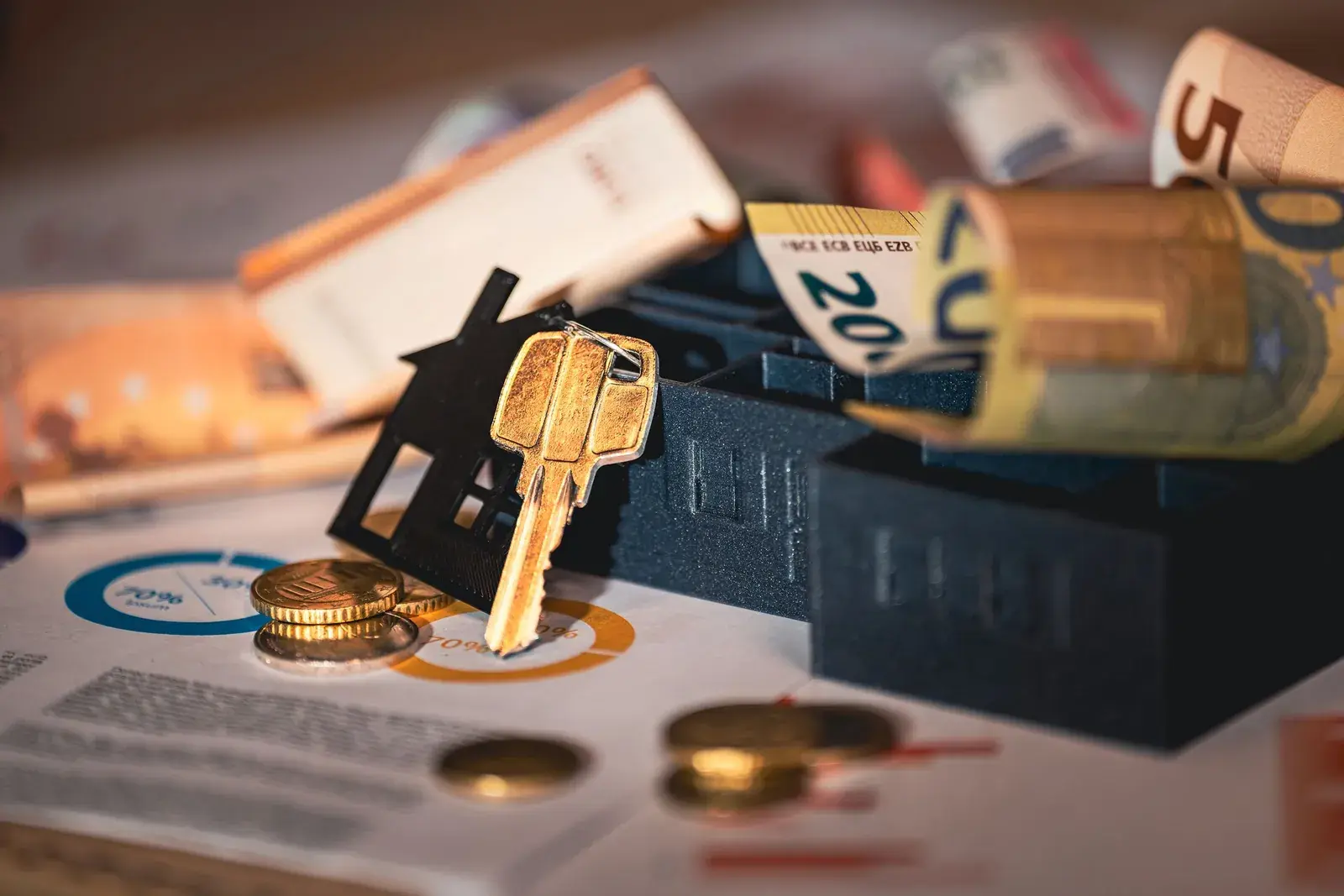
Paying for a house in Albania by bank transfer is the route the law provides for, while cash payments have clear limits. Since the end of January 2026, a business, which includes a construction company, cannot sell to you for cash above 500,000 lek per transaction. The notary (noteri) does not handle cash transactions above 150,000 lek, and the official sale procedure runs through the notary's special escrow account: the seller receives the money within 24 hours after the notary receives the ownership certificate in your name.
Main photo: Jakub Zerdzicki / Pexels
- Cash limit when you buy from a business
- 500,000 lek
- Cash limit at the notary
- 150,000 lek
- Depositing the amount in the notary's escrow account
- 4,000 lek
- Cash that must be declared at customs
- 10,000 €
The rules below are those in force on 10 October 2026. We have explained the deposit (kapari) in the preliminary contract and the deposit, and the buying steps in how to buy a house in Albania.
Can you pay for a house in Albania in cash?
Yes, but only within certain thresholds, which depend on who is selling and who handles the money:
| Cash payments between two businesses | Up to 100,000 lek (about 1,090 €) | Law no. 9920/2008, article 59, point 1 |
|---|---|---|
| A business's cash sales to or purchases from individuals | Up to 500,000 lek (about 5,460 €) | Law no. 9920/2008, article 59, point 3 |
| Notary cash transactions | Up to 150,000 lek (about 1,640 €) | Law no. 110/2018, article 68 |
| Notary, agent and developer verify the client | From 1,000,000 lek (about 10,910 €) | Law no. 9917/2008, article 4 |
| Physical cash transaction reported to the FIU (AIF) | From 1,000,000 lek | Law no. 9917/2008, article 12 |
| ASHK reports the sale registration to the FIU (AIF) | From 6,000,000 lek (about 65,470 €) | Law no. 9917/2008, article 19 |
| Cash declared at customs | From 10,000 € | Law no. 9917/2008, article 17/1 |
The 500,000 lek limit is new: it was added by Law no. 79/2025, published in the Official Gazette (Fletorja Zyrtare) on 15 January 2026, for “natural persons, sole traders and the self-employed or entities”. When you buy from a construction company, any payment above this amount, whether a deposit or an instalment, is made through a bank.
When the seller is a private individual who does not run a business, the text of the tax law does not clearly address the case, while the new anti-money-laundering draft law, which the Financial Intelligence Agency (AIF) put out for consultation in August 2026, exempts payments between persons who are not acting as professionals from the limit. Cash, however, runs into the notary: the notary will not handle more than 150,000 lek of it and, as a subject of the anti-money-laundering law, reports physical cash transactions from 1,000,000 lek.
The tax administration lists the heavy use of cash among the main risks of the property market (NAREA conference, 21 September 2026, according to Monitor).
How does the notary's escrow account work?
You pay the price into the notary's special bank account, and the notary passes the money to the seller only after the property has been registered in your name. The procedure is set by joint instruction no. 20 of 14.9.2020 of the Ministers of Finance and of Justice. Before the contract, the notary must inform you of the “legal obligation” for the price to be paid through this account (point 3). Then:
- After the deed is signed, the notary gives you the account details; you transfer the price and present a copy of the deed to the bank (point 5).
- You prove the payment with the bank document, and the notary submits the deed to ASHK (the State Cadastre Agency, Agjencia Shtetërore e Kadastrës) together with it (points 6 and 7).
- If the seller has tax to pay, the notary can pay it from the deposited amount, with the seller's written consent or as provided in the deed (point 8).
- Within 24 hours of receiving the certificate in your name, the notary transfers the amount to the seller, deducting the bank commission and the tax paid (point 9).
With instalments, the notary passes on each instalment within 24 hours after the deed has been registered and the instalment deposited, and the last instalment after receiving the certificate (points 10 and 11). A deposit paid earlier, or the amount the bank pays with a mortgage, is recorded in the deed; ask the notary in advance how they organise the payment.
What protects you and what it costs
- The account is an escrow account, interest-free and separate from the notary's own money, and the notary may not hold clients' money in personal accounts (Instruction no. 20/2020, point 2; no. 16/2020, point 15).
- The notary does not withdraw cash from it, only makes transfers as set out in the deed, and bailiffs and the tax authorities cannot touch it for the notary's debts (Law no. 110/2018, article 68; Instruction no. 20/2020, point 16).
- If the notary is suspended, arrested or dies, the National Chamber of Notaries appoints a substitute who completes the payments (article 68).
- Depositing the amount costs 4,000 lek (Joint instruction no. 22/2020) and, as a contract expense, it is paid by the buyer unless you agree otherwise (Civil Code, article 708).
The other fees are in notary fees for a property sale, and all the costs together in the costs of buying property.
For an apartment under construction, the contract with the developer can be paid either through the notary or into the parties' bank accounts (Instruction no. 16/2020, point 3). When the notary holds an amount in safekeeping to give to someone and cannot pass it on within the deadline written in the deed, it is returned to the depositor on the day after the deadline expires (point 13), so ask for the deed to include a deadline.
What does the notary ask about the source of funds?
The notary identifies you, records in the deed how the price is paid (Law no. 110/2018, article 105) and, when they see it as necessary, asks you where the money comes from. The anti-money-laundering law (no. 9917/2008, most recently amended by Law no. 37/2026) makes notaries, lawyers, real estate agents, builders and banks subject to it (article 3). For transactions from 1,000,000 lek, they identify you, gather information on the purpose and, when necessary, on the source of funds (articles 4 and 4/1); for politically exposed persons and their family members, also on the source of wealth (article 8).
- No answers, no contract. When the notary cannot complete this check, they do not carry out the transaction and report to the FIU (AIF) (article 4/1).
- A possible delay. When in doubt, the notary does not carry out the operation and asks the FIU (AIF), which replies within 48 hours (article 12).
- The notary will not tell you that they have filed a report: the law forbids it (article 15).
The property documents, for the buyer and the seller, are in documents for buying a house.
How to pay by bank transfer without mistakes
Pay only into the account of the seller shown on the ownership certificate or into the notary's special account. When there are several sellers, each one is paid for their own share, as explained in the article on properties with several owners.
Photo: Liridon / Wikimedia Commons, CC BY-SA 4.0
With a mortgage, ask the bank how it disburses the amount and ask for the deed to record it; the offers are in home loans. Scams involving the deposit and bank details are covered in online property scams.
How do you pay from abroad?
By transfer from your bank to the notary's or the seller's account. Since 7 October 2025 Albania has been a functional part of SEPA, so a euro transfer from the SEPA area can be made as a SEPA payment, which according to the Bank of Albania is cheaper and faster. Ask which currency the account you are paying into is in, so you do not pay for the exchange twice.
If you cannot come, someone can sign for you with a special power of attorney. Loans are in loans for emigrants, the steps in the guide to buying from abroad, and for sellers in selling property from abroad.
Cash at the border
Anyone entering or leaving Albania with 10,000 € or more in cash, bearer instruments, precious metals or precious stones must declare it at customs, with the purpose and supporting documents (Law no. 9917/2008, article 17/1). According to the Customs Administration, the declaration is free, made with the RTVK form at the border crossing before passport control, however you travel and even when the money is not yours.
| 10,000 to 19,999 € | 20,000 lek | 10% of the amount | 30% of the amount |
|---|---|---|---|
| 20,000 to 49,999 € | 40,000 lek | 20% of the amount | 40% of the amount |
| Over 50,000 € | 60,000 lek | 30% of the amount | 50% of the amount |
Besides the fine, the case is dealt with under the Criminal Code. Leaving an EU country with 10,000 € or more in cash must also be declared at that country's customs. When you deposit it in Albania, deposits from 1,000,000 lek are reported to the FIU (AIF) (article 12), and the customs declaration helps you prove the source.
What goes wrong when you pay in cash?
The main problem is proof of payment:
- Witnesses are not enough. Payment of a monetary obligation arising from a written contract cannot be proven by witnesses (Code of Civil Procedure, article 232), except in limited cases such as “a beginning of written proof” (article 233). A deposit paid in cash without a receipt may be impossible to prove.
- A receipt is your right. For every payment, the creditor issues a receipt, unless the contract says otherwise (Civil Code, article 473). Without one, the rule that a seller at fault returns double the deposit (article 602) helps you little.
- Buyers of off-plan homes. The government's draft law of 2 September 2026 on confiscated buildings recognises buyers' payments only when they were made through a bank, with a notarial contract registered with ASHK before the confiscation (Monitor).
- Reselling. The 15% tax is calculated on the difference between the sale price and the purchase price (Law no. 29/2023, article 17), so a purchase price understated in the contract increases your future tax.
Do not accept a lower price in the contract with the difference paid in cash. The notary fee and the seller's tax are calculated at least on the reference price anyway, the cash part cannot be proven, and when you resell you pay more tax. Also, do not pay into the account of anyone other than the seller shown on the certificate.
Frequently asked questions
Sources
- Ligji nr. 9920/2008 “Për procedurat tatimore”, i përditësuar: neni 59 ·
- Ligji nr. 79/2025, Fletorja Zyrtare nr. 11, 15.1.2026 ·
- Ligji nr. 9917/2008 kundër pastrimit të parave, i përditësuar me Ligjin nr. 37/2026 ·
- Ligji nr. 110/2018 “Për noterinë”: nenet 68, 105 dhe 133 ·
- Udhëzimi i përbashkët nr. 20, datë 14.9.2020: pagesa në kalimin e pasurive të paluajtshme ·
- Udhëzimi nr. 16, datë 30.7.2020: fondet e klientëve te noteri ·
- Udhëzimi i përbashkët nr. 22, datë 20.10.2020: tarifat e noterit ·
- Kodi Civil, i përditësuar më 10.8.2026: nenet 473, 602 dhe 708 ·
- Kodi i Procedurës Civile, i përditësuar më 25.2.2026: nenet 232 dhe 233 ·
- Ligji nr. 29/2023 “Për tatimin mbi të ardhurat”: neni 17 ·
- Administrata Doganore: deklarimi i parave ·
- Your Europe: paratë në dorë në hyrje dhe dalje nga BE ·
- Banka e Shqipërisë: Shqipëria në SEPA, 7.10.2025 ·
- Banka e Shqipërisë: kursi zyrtar i këmbimit ·
- AIF: projektligji i ri kundër pastrimit të parave, konsultim publik, gusht 2026 ·
- Monitor: Tatimet, 2 800 tatimpagues në tregun e pasurive të paluajtshme, 21.9.2026 ·
- Monitor: Qeveria ndryshon ligjin për objektet e konfiskuara, 2.9.2026 ·
Read more
Share the article
New articles by email
Guides on buying, renting and the property market in Albania, straight to your inbox.
One email when we publish a new article. You can unsubscribe at any time. Privacy
Comments
Log in to join the conversation.
No comments yet. Be the first to share your view.